

BTEC Level 5 Unit 5048 Industrial Automation (J/650/2990) Assignment: PROFINET, PLCs and Sensors
| University | Pearson College London (PCL) |
| Subject | Unit 5048: Sensors and Automation |
Introduction
Modern developments and applications of automation in industry rely on complex and highly reliable industrial communication networks. Industrial communication is typically a mixture of multilayered, multidimensional networks involving fieldbuses, software packages, media, and a host of other tools. To be able to install, commission, maintain and troubleshoot an industrial plant, a competent engineer requires a good understanding of sensor and actuator technologies and core communication technologies. This unit equips students with the requisite knowledge of sensors and actuators and the key skills underpinning popular industrial communication networks, such as PROFINET, Ethernet IP, Modbus, IO Link and EtherCAT, thereby extending the breadth of employment to which students pursuing a career in network technologies can aspire.
Thus, this unit aims to provide students with the skills and competencies required to work in the areas of industrial computer control, automation, and Industry 4.0. Fundamental concepts underpinning the use of sensors and industrial communication networks for automation are introduced, and students are given the essential knowledge and skills required for the use of Ethernet-based technology in support of real-time industrial network environments. An appreciation of technologies using wire pairs, fibre optics, satellites and microwave transmission will be provided.
The unit will provide specialist knowledge for work with industrial controllers (e.g. programmable logic controllers (PLCs)) in the areas of manufacturing and automation using popular network technologies such as PROFINET, together with an appreciation of security aspects in relation to network- and cloud-based solutions.
On successful completion of this unit, students will have gained knowledge and skills in the application of PLCs to industrial control, and the design, development and evaluation of Ethernet-based communication and automation systems. Through appropriate tasks and assignments, students will be exposed to good engineering practices in software engineering, and in the installation, testing and maintenance of networked automation systems.
Learning Outcomes
By the end of this unit, students will be able to:
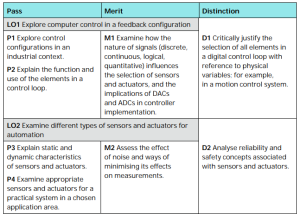
LO1 Explore computer control in a feedback configuration
LO2 Examine different types of sensors and actuators for automation
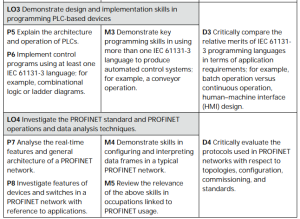
LO3 Demonstrate design and implementation skills in programming PLC-based devices
LO4 Investigate the PROFINET standard and PROFINET operations and data analysis techniques.
Are You Searching Answer of this Question? Request British Writers to Write a plagiarism Free Copy for You.
Essential Content
LO1 Explore computer control in a feedback configuration
Types of control systems:
- Industrial control systems
- Continuous-time and discrete control
- Types of controllers – continuous, discrete and logical
- Applications of different types control systems in chosen occupation/sector (e.g., space, aeronautical, mechanical, manufacturing etc.).
Control configurations:
- Open-loop systems
- Closed-loop systems
- Feedback, feedforward and cascade loops.
Control-loop elements:
- Essential components in a control loop
- Sensors and actuators – definition and examples
- Data acquisition, roles of analogue-to-digital converter (ADC) and digital-to-analogue converter (DAC).
LO2 Examine different types of sensors and actuators for automation
Overview of measurement concepts:
- Physical process variables: static and dynamic characteristics
- Signals and noise in measurements.
Sensors for automation:
- Measurement of physical quantities: typical sensors to measure temperature, pressure, flow, speed, position, and so on
- Concepts of range, calibration, precision, reliability, limitations and appropriate use, and so on.
Actuators for automation:
- Common actuators, characteristics and uses – valves, servomotors, and so on; control and safety concepts.
LO3 Demonstrate design and implementation skills in programming PLC-based devices
Programmable logic controllers (PLCs):
- Architecture, operation, scan cycle, inputs and outputs
- CPU, input and output modules, addressing convention
- Examples of industrial application (e.g. satellite and microwave transmission, avionics systems for remote sensing, geophysical multisensor system, microsensors, electronic and optical actuation, bespoke PLC network products).
Programming for PLCs:
- Programming using IEC 61131-3 standard languages such as ladder diagrams, function block diagrams, continuous function charts, structured text and sequential function charts
- Project configuration, program organisation units (POUs), tasks
- Application development using software environments; for example, human–machine interface (HMI) design using CODESYS and Siemens S7 PLCs
- Network automation applications and related tools and platforms.
Skills and competencies:
- Industrial computer control, automation, Industry 4.0 and beyond
- Integration of automation and digital systems, and impact on organisations.
LO4 Investigate the PROFINET standard and PROFINET operations and data analysis techniques.
Industrial communication networks:
- PROFINET, Ethernet IP, Modbus, IO Link, EtherCAT and other equivalent options
- Overview of operation and maintenance: types of network maintenance, monitoring and diagnostics; evaluation and implementation of maintenance procedures; troubleshooting methodologies, tools and techniques for networks and IT infrastructure; workforce roles such as engineering technician, network engineer, systems engineer, and relevant competencies; occupational standards to meet sector demands).
Get Solution of this Assessment. Hire Experts to solve this assignment for you Before Deadline.
Overview of PROFINET systems:
- Requirements of real-time control networks
- Network topologies (e.g., bus, ring, start, tree, mesh, and hybrid) used in PROFINET networks
- The PROFINET standard
- Application areas for PROFINET networks (including organisational context, PROFINET Network Engineer roles and occupational relevance, CPD).
Design and implementation of PROFINET systems:
- PROFINET system design, protocols and principles of operation
- PROFINET installation, troubleshooting (e.g., isolate, repair and escalate faults based on data) and maintenance in the context of Industry 4.0
- Use of appropriate software and hardware tools; for example, ProfiTrace, Wireshark
- Use of cloud-based systems for maintenance and analytics.
Learning Outcomes and Assessment Criteria
Recommended Resources
Note: See HN Global for guidance on additional resources.
Print Resources
- Groover, M.P. (2020) Automation, Production Systems, and Computer-Integrated Manufacturing. 5th Ed. Addison Wesley.
- Love, J. (2007) Process Automation Handbook: A Guide to Theory and Practice. Springer-Verlag.
- Popp, M. (2015) Industrial communication with PROFINET. PROFIBUS Nutzerorganisation e.V. (PNO).
- Powell, J. and Vandelinde, H. (2015) Catching the Process Fieldbus: An introduction to PROFIBUS and PROFINET. 2nd Ed. Siemens Milltronics Process Instruments.
Websites
- http://www.profibus.com PROFIBUS & PROFINET International (PI) (General reference)
- http://www.profibusgroup.com PROFIBUS.PROFINET United Kingdom ‘All about PROFIBUS, PROFINET, IO-Link and omlox in the UK’ (General reference)
- http://www.profinews.com PROFINEWS ‘PROFINET, PROFIBUS, IO-Link, and omlox news from around the world’ (General reference)
- http://www.automation.com Automation.com ‘A subsidiary of the International Society of Automation’ (General reference)
- http://www.controleng.com Control Engineering ‘Control Engineering Magazine’ (General reference)
- http://www.controlglobal.com Control (General reference)
Stuck in Completing this Assignment and feeling stressed ? Take our Private Writing Services
Journals
Note: Example journals listed below provide a broad range of articles related to unit content and those relevant for the qualification. Staff and students are encouraged to explore these journals and any other suitable journals to support the development of academic study skills, and subject specific knowledge and skills as part of unit level delivery.
Control Engineering Practice. ISSN: 0967-0661.
IET Control Theory and Applications. ISSN: 1751-8644.
This BTEC Level 5 Unit 5048 Industrial Automation (J/650/2990) assignment covers industrial communication networks such as PROFINET, PLC programming, sensors and actuators, and feedback control in Industry 4.0 systems. The tutors at btecassignment offer BTEC Level 5 engineering assignment help with planning, research, structure and the Merit and Distinction criteria. Browse more BTEC engineering assignment briefs or our BTEC Level 5 engineering samples. Short on time? Ask us to do my BTEC assignment.

BTEC Level 4 Diploma in Business Administration Unit 3 Managing Self Development Assignment Brief
This Pearson BTEC Level 4 Diploma in Business Administration Unit 3 Managing Self Development assignment asks you to assess your own personal and professional development...
Read More >>HNC Construction Unit 1 Individual Project Assignment Brief: Energy Efficient Construction
This HNC Construction and the Built Environment Unit 1 Individual Project assignment, "The need for energy efficient construction solutions", asks you to act as a...
Read More >>BTEC Level 3 Unit 36 Programmable Logic Controllers Assignment Brief: Programming PLCs
This BTEC Level 3 Engineering Unit 36 Programmable Logic Controllers assignment, "Programming PLCs", covers Learning Aim B. You write a report for a small hydroelectric...
Read More >>BTEC Level 3 Unit 5 Data Modelling Assignment 2 Brief: Design and Develop a Data Model
This BTEC Level 3 IT Unit 5 Data Modelling assignment, "Design and Develop a Data Model to Meet Client Requirements", covers Learning Aims B and...
Read More >>Unit 22 Market Research Assignment Brief | BTEC International Level 3 Business
This Unit 22 Market Research assignment, "Market research in action", asks Pearson BTEC International Level 3 Business learners to examine the market research methods a...
Read More >>Unit 21 Geotechnics and Soil Mechanics (L/618/8101) Assignment Brief
This Unit 21 Geotechnics and Soil Mechanics (L/618/8101) assignment asks HNC Construction and Civil Engineering learners to write a preliminary geotechnical design report for a...
Read More >>Unit 27 Identifying Entrepreneurial Opportunities: British Academy of Jewellery HNC Assignment
Unit 27 Identifying Entrepreneurial Opportunities Assignment Brief Centre: British Academy of Jewellery Qualification: BTEC (RQF) Higher National Certificate in Business: Entrepreneurship and Small Business Management...
Read More >>Unit 4 Leadership and Management in the Workplace: Michael Page Case Study (L/618/5036)
This Unit 4 Leadership and Management (L/618/5036) assignment, Leadership and Management in the Workplace (Assignment 1 of 2), asks you to write a case study...
Read More >>Unit 5003 Advanced Mechanical Principles Assignment Brief 2026
Unit 5003 Assignment Brief Qualification Pearson BTEC Higher Nationals in Engineering Unit Number 5003 Unit Title Advanced Mechanical Principles Unit Code K/651/0810 Unit Level 5...
Read More >>Unit 5002 Professional Engineering Management Assignment Brief 2026
Unit 5002 Assignment Brief Qualification Pearson BTEC Higher Nationals in Engineering Unit Number 5002 Unit Title Professional Engineering Management Unit Code F/651/0809 Unit Level 5...
Read More >>Unit 4039 Semiconductor Manufacture Assignment Brief 2026
Unit 4039 Assignment Brief Qualification Pearson BTEC Higher Nationals in Engineering Unit Number 4039 Unit Title Semiconductor Manufacture Unit Code L/651/0768 Unit Level 4 Credits...
Read More >>BTEC level 4 Unit 4030 Industry 4.0 (F/651/0755) Assignment Brief 2026
Unit 4030 Industry 4.0 Assignment Brief Unit Number 4030 Unit Title Industry 4.0 Unit Reference Number F/651/0755 Unit Level 4 Credits 15 Introduction Industry 4.0...
Read More >>Unit 16 Principles of Public Health Engineering Assignment Brief 2026
Unit 16 Principles of Public Health Engineering Assignment Qualification Pearson BTEC Higher Nationals Construction Unit Number 16 Unit Title Principles of Public Health Engineering Unit...
Read More >>Unit 14 Principles of Refurbishment Assignment Brief 2026
Unit 14 Principles of Refurbishment Assignment Brief Qualification Pearson BTEC Higher Nationals Construction Unit Number 14 Unit Title Principles of Refurbishment Unit code A/618/8093 Unit...
Read More >>Unit 13 Building Information Modelling Assignment Brief 2026
Unit 13 Building Information Modelling Assignment Brief Qualification Pearson BTEC Higher Nationals Construction Unit Number 13 Unit Title Building Information Modelling Unit code T/618/8092 Unit...
Read More >>Unit 12 Tender and Procurement Assignment Brief 2026
Unit 12 Tender & Procurement Assignment Brief Qualification Pearson BTEC Higher Nationals Construction Unit Number 12 Unit Title Tender & Procurement Unit code M/618/8091 Unit...
Read More >>Unit 11 Financial Management & Business Practices in Construction Assignment Brief 2026
Unit 11 Financial Management & Business Practices in Construction Assignment Brief Qualification Pearson BTEC Higher Nationals Construction Unit Number 11 Unit Title Financial Management & Business...
Read More >>Unit 9 Principles of Heating, Ventilation and Air Conditioning Assignment Brief 2026
Unit 9 Principles of Heating, Ventilation and Air Conditioning Assignment Brief Qualification Pearson BTEC Higher Nationals Construction Unit Number 9 Unit Title Principles of Heating,...
Read More >>Unit 7 Surveying, Measuring and Setting-out Assignment Brief 2026
Unit 7 Surveying, Measuring & Setting-out Assignment Brief Qualification Pearson BTEC Higher Nationals Construction Unit Number 7 Unit Title Surveying, Measuring & Setting-out Unit code...
Read More >>Unit 8 Mathematics for Construction (K/618/8087) Assignment Brief 2026
Unit 8 Mathematics for Construction Assignment Brief Qualification Pearson BTEC Higher Nationals Construction Unit Number 8 Unit Title Mathematics for Construction Unit code K/618/8087 Unit...
Read More >>