P5E19 Unit 19 Principles of Structural Design Assignment Brief
| Qualification | Pearson BTEC Level 5 Higher National Diploma in Construction and the Built Environment |
| Module Code | P5E19 |
| Module Title | Principles of Structural Design |
| Unit code | D/618/8099 |
| Unit level | 4 |
| Credit value | 15 |
Submission Requirement
| Font | Times New Roman |
| Font Size | 12 font |
| Spacing | Single Line Spacing |
| Margin | 2 cm (Left-side only) |
| Printing | 1-Sided |
| Number of Words (Approx.) | 1) At least 3 pages answer of each question (400-500 words) excluding diagrams or pictures |
Submission Format
This assignment can be either hand written or typed in full, but all working must be shown in order to demonstrate your understanding of the tasks. It is recommended that you make a copy of their assignment for their own records, if it is hand written.
Learning Outcomes
By the end of this unit, students will be able to:
LO1 Calculate bending moments and shear forces for simply supported steel and concrete beams
LO2 Determine deflection for different types of beams and loading conditions
LO3 Calculate the axial load carrying capacity of steel and reinforced concrete columns
LO4 Explore design methods for steel, reinforced concrete beams and columns.
Assignment Brief and Guidance
Task 1
Determine the following by calculations and diagrams: bending moments and shear force in simply supported steel beams with point loads and uniformly distributed loads.
Part a)
Calculate the support reactions of beam Figure 1 and draw the shear force and bending moment diagrams identifying the value for the maximum positive and negative values of bending moment. (Use the table below for your individual loading values)
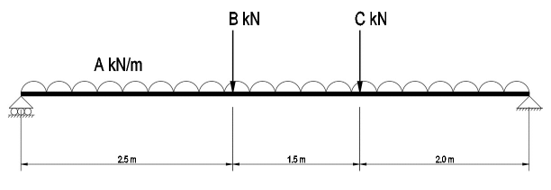
Figure 1
| A kN/m | B kN | C kN | |
| 1 | 20 | 25 | 20 |
| 2 | 25 | 30 | 25 |
| 3 | 30 | 35 | 30 |
| 4 | 35 | 40 | 35 |
| 5 | 20 | 30 | 25 |
| 6 | 25 | 35 | 30 |
Part b)
Calculate the support reactions of beam Figure 2 and draw the shear force and bending moment diagrams identifying the value for the maximum positive and negative values of bending moment. (Use the table below for your individual loading values)
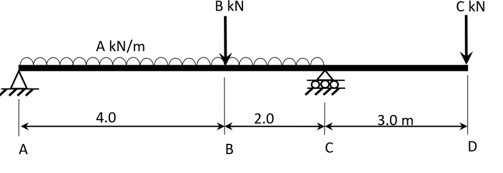
| No. | A (kN/m) | B (kN) | C (kN) |
|---|---|---|---|
| 1 | 30 | 40 | 35 |
| 2 | 35 | 25 | 20 |
| 3 | 20 | 35 | 30 |
| 4 | 25 | 40 | 35 |
| 5 | 50 | 25 | 60 |
| 6 | 40 | 35 | 55 |
Task 2
a) Discuss the statutory requirements for structural design safety
b) For the situation below determine all possible valid load combinations and valid partial factors of safety for live loads, dead loads and imposed loads; based on current codes of practice and regulations (eurocodes).
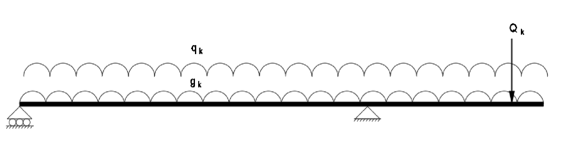
c) Evaluate how maximum bending moments determine steel beam selection, using current codes of practice and approved documents in terms of economics and safety
Task 3
a) For the mild steel beam 533 x 165 UB 66 shown below in Figure 3 calculate the maximum deflection and determine if this satisfies serviceability limit state. The loads are all unfactored imposed
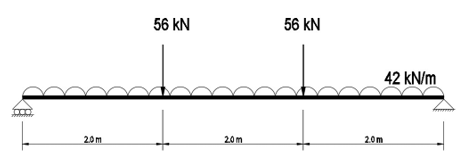
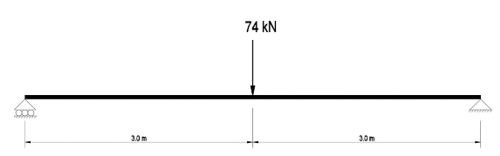
b) Using Macaulay’s Theorem determine the maximum deflection of the beam shown in figure
c) Explain how the deflection of beams can affect structural stability
d) Investigate the different types of support for beams, analyse how they affect the deflection of a beam and how the deflection affects structural stability in designs
Task 4
a) Describe the concepts of slenderness ratio and effective length and explain how this affects the load carrying capacity of columns.
b) Investigate the materials used in structural design of beams and columns in fixed structures and analyse their load carrying capacity, size, weight and corrosion resistance properties.
Task 5
The lead the structural engineer has asked you to determine the maximum axial load that can be carried for the scenarios below.
Scenario 1
Use a 203×203 UC86 with pinned ends a grade S355
Scenario 2
250×250 square concrete column
Grade of concrete C35/45
Reinforcement 4H25 bars
M3
For the scenario below assess the most effective support method, in terms of ease and speed of construction, economics, safety and environmental factors. Consider different materials and different joint systems.
A four storey office block has a grid spacing of 5.6m x 4.4m. The floors are 180mm deep r.c. with a sand cement screed of 80 mm spanning the shorter distance. 140mm fair face concrete block walls are built on the 4.4m spanning beams Floor to floor height is 3.6m
Task 6
Develop a design solution, including beam designs and column designs, for the scenario below
A four storey office block has a grid spacing of 5.6m (5 bays)x 4.4m (4 bays)
The floors are 180mm deep reinforced concrete with a sand cement screed of 80 mm.
External Envelope
100mm facing brick external leaf
100mm cavity filled with mineral wool
140mm fair face concrete block walls internal leaf
Floor to floor height is 4.0m.
Produce a design solution in either steel or reinforced concrete.
Task 7
For the structural design produced in Task 6 provide appropriate drawings and specifications in support of the structural design solution
Provide details of concrete strength, size of beam and detail the reinforcement required
Task 8
Evaluate the use of an alternative material in achieving a design solution, discussing the benefits or challenges associated with it.
Assess the use of Building Information Modelling in the production of accurate structural design information and the collaborative environment of structural design
Learning Outcomes and Assessment Criteria
| Pass | Merit | Distinction |
| LO1 Calculate bending moments and shear forces for simply supported steel and concrete beams |
D1 Evaluate how maximum bending moments determine steel beam selection, using current codes of practice and approved documents in terms of economics and safety. |
|
| P1 Determine the following by calculations and diagrams: bending moments and shear force in simply supported steel beams with point loads and uniformly distributed loads.
P2 Discuss the statutory requirements to ensure safety in structural designs. |
M1 Produce valid factors of safety for live loads, dead loads and imposed loads, using current codes of practice and building regulations. | |
| LO2 Determine deflection for different types of beams and loading conditions |
D2 Assess the most effective support method for a given scenario, in terms of ease and speed of construction, economics, safety and environmental factors. |
|
| P3 Calculate the deflection for different types of beam under different loading conditions.
P4 Explain how deflection in beams affects structural stability. |
M2 Analyse different support methods and their effect on deflection in fixed structures. | |
| LO3 Calculate the axial load carrying capacity of steel and reinforced concrete columns | ||
| P5 Describe the concepts of slenderness ratio and effective length.
P6 Determine the axial loadcarrying capacity of steel columns and reinforced concrete columns. |
M3 Analyse the loadcarrying capacity, size, weight and corrosion resistance properties of different materials used for beams and columns in fixed structures. | |
| LO4 Explore design methods for steel, reinforced concrete beams and columns |
D3 Assess the use of Building Information Modelling in the production of accurate structural design information and the collaborative environment of structural design. |
|
| P7 Develop a design solution, including beam design and column design, for a given scenario.
P8 Produce drawings and specifications in support of a structural design solution. |
M4 Evaluate the use of an alternative material in achieving a design solution, discussing the benefits or challenges associated with it. | |
Recommended Resources
Print resources
ARYA, C. (2009), Design of Structural Elements, CRC Press
BHATT, P., MACGINLEY, T., CHOO, B. (2014), Reinforced Concrete Design to Eurocodes, CRC Press
COBB, F. (2020), Structural Engineer’s Pocket Book British Standards Edition, CRC Press
MCKENZIE, W. (2015), Design of Structural Elements, Macmillan International Higher Education
MOSLEY, W., HULSE, R., BUNGEY, J. (2012), Reinforced Concrete Design, Macmillan International Higher Education
NAGEIM, H., DURKA, F. (2003), Structural Mechanics, Pearson Education
OZELTON, E., BAIRD, J. (2008), Timber Designers’ Manual, John Wiley & Sons REYNOLDS, C., STEEDMAN, J., THRELFALL, A. (2007), Reinforced Concrete Designer’s Handbook, Eleventh Edition, CRC Press
SEWARD, D. (2014), Understanding Structures, Macmillan International
Higher Education
SMITH, P. (2001), An Introduction to Structural Mechanics, Macmillan International Higher Education
SOMAYAJI, S. (2001), Civil Engineering Materials, Pearson College Division
Links
This unit links to the following related units:
- Unit 2: Construction Technology
- Unit 3: Science & Materials
- Unit 6: Digital Applications for Construction Information
- Unit 13: Building Information Modelling
- Unit 17: Civil Engineering Technology
- Unit 32: Advanced Construction Drawing & Detailing
- Unit 34: Further Mathematics for Construction
- Unit 35: Sustainable Methods of Construction
- Unit 41: Highway Engineering
- Unit 45: Advanced Materials
- Unit 47: Advanced Building Information Modelling
Are You Searching Answer of this Question? Request British Writers to Write a plagiarism Free Copy for You.
Chat Now